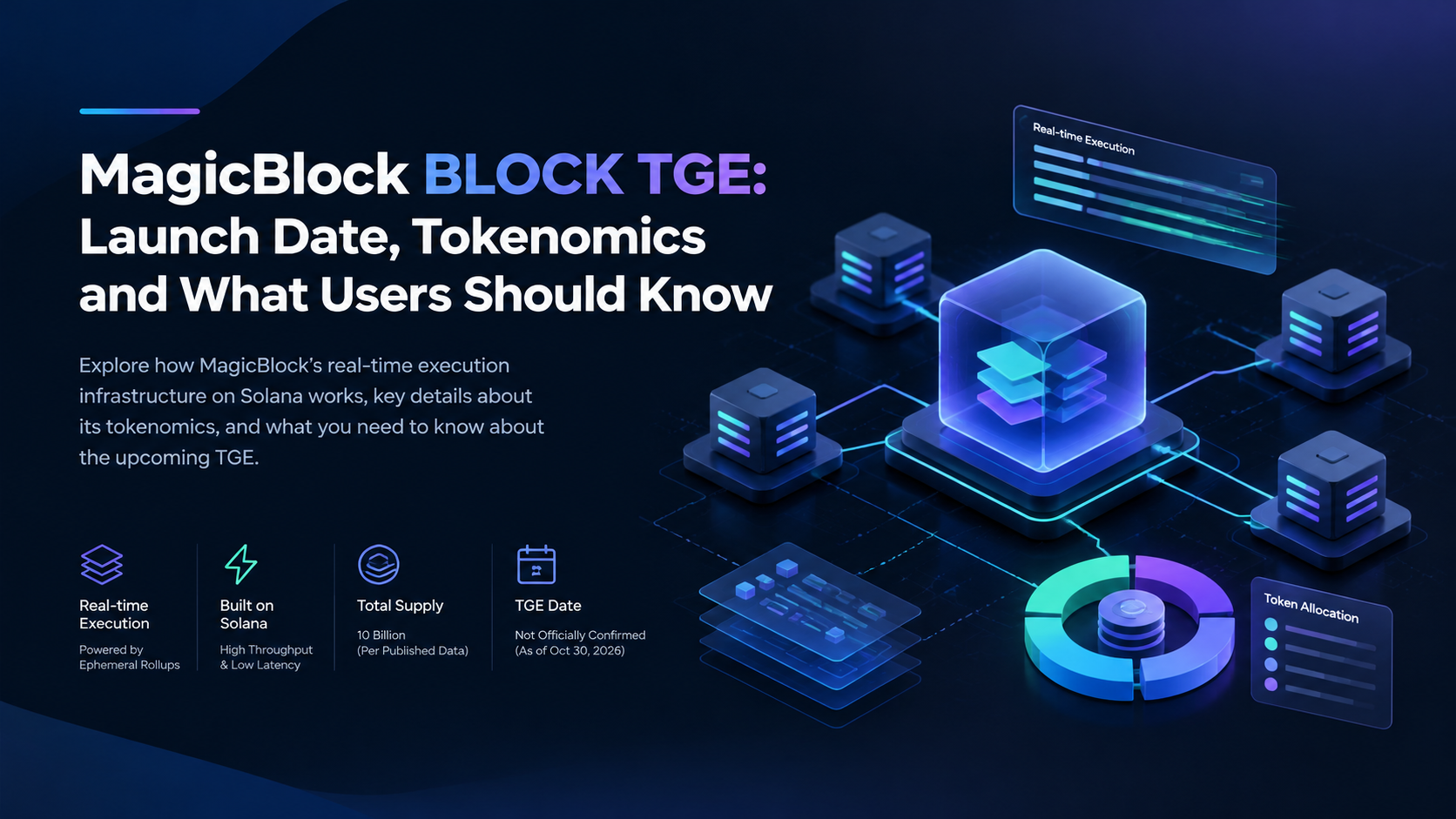
MagicBlock’s BLOCK token has attracted attention among Solana users and infrastructure-focused investors, but its token generation event has not followed the original timeline. The project completed its presale in February 2026 and initially targeted a launch around the end of Q1 or the beginning of Q2. That window has passed without a confirmed replacement date. For anyone researching the MagicBlock BLOCK TGE, the important questions now go beyond the launch schedule: what does the token actually do, how is its 10 billion supply distributed, what did presale participants receive, and what has changed in the project while the market waits?
No officially confirmed TGE date or new launch window has been published in the sources reviewed. The February 2026 presale is complete, but the token has not entered confirmed public exchange trading. The original late-Q1 / early-Q2 target should be treated as an outdated target, not a current launch schedule.
1. When Is the MagicBlock BLOCK TGE?
The direct answer is that there is currently no confirmed public TGE date. MagicBlock originally indicated that the token launch was expected around late Q1 or early Q2 2026. That estimate was associated with the project’s February tokenomics and presale announcement.
However, the expected period passed without a confirmed launch. A review of the project’s subsequent public information and independent tracking records still shows BLOCK as pre-TGE. The TGE Index project record, last checked on October 16, 2026, also lists the event as having no official date or window. Solana Compass reported the same status in its October 24 project review.
This distinction matters because some third-party calendars may display estimated Q4 2026 dates or other projected launch windows. Unless the project itself confirms a date, these should not be treated as official information. A predicted date can help describe market expectations, but it cannot establish when tokens will become transferable or when exchange trading will begin.
BLOCK TGE timeline
| Date | Event | What It Means |
|---|---|---|
| September 2024 | Pre-seed funding | $3 million funding through a16z CSX. |
| April 2025 | Seed funding | $7.5 million seed round led by Lightspeed Faction. |
| February 2, 2026 | Tokenomics announcement | 10 billion BLOCK supply and allocation structure disclosed. |
| February 5–8, 2026 | Presale | Three-day sale with two participation options. |
| Late Q1–early Q2 2026 | Original TGE target | Initial expected period, subsequently missed. |
| March 2026 | Private Payments API | Private payment functionality went live on Solana mainnet. |
| October 6, 2026 | Validator v1.0 | A significant infrastructure release. |
| October 30, 2026 | Current status | No confirmed public TGE date. |
The timeline shows an important difference between token development and product development. The absence of a token launch does not mean the infrastructure has stopped progressing. At the same time, product releases should not be interpreted as evidence that a TGE is imminent.
2. What Is MagicBlock and Why Does It Need BLOCK?
MagicBlock is a real-time execution infrastructure project built around Solana. Its central technology is called Ephemeral Rollups. Rather than moving an application permanently to a completely separate blockchain, this architecture allows selected Solana accounts to be delegated to a temporary execution environment. Transactions can then be processed in that environment before the resulting state is committed back to Solana.
This design addresses a practical limitation of fully onchain applications. Games, trading interfaces, and interactive applications often need much faster feedback than a conventional blockchain transaction flow can provide. Requiring users to approve every small action through a wallet can also interrupt the experience.
How Ephemeral Rollups work
A simplified workflow looks like this:
- Account delegation: An application delegates selected Solana accounts to an Ephemeral Rollup.
- Fast execution: The delegated state is processed by a specialized SVM-compatible execution environment.
- Application interaction: Users can perform repeated actions without requiring every interaction to settle directly on Solana.
- State commitment: The resulting changes are committed back to Solana when the session or application workflow requires it.
MagicBlock’s architecture is therefore different from a conventional independent Layer 2 that maintains a separate ecosystem of assets and liquidity. It is designed to extend Solana applications while keeping their underlying accounts and assets connected to Solana.
According to the technical overview in Solana Compass, the system targets sub-50-millisecond end-to-end latency. This is a project-level performance claim, not a guarantee that every application will achieve identical results under all network conditions.
Where BLOCK fits into the infrastructure
BLOCK is intended to coordinate and economically support the network of Ephemeral Rollup operators. The token is not simply a payment coin attached to a software product. Its proposed role is more closely related to infrastructure participation and operator accountability.
The published token design describes several functions:
- Staking: Node operators stake BLOCK to participate in network operations.
- Delegation: Token holders can delegate their stake to operators, according to the proposed network model.
- Slashing: Operators may face penalties for failing to meet network performance or uptime requirements.
- Incentives: Programmatic rewards are intended to encourage measurable contributions to the network.
- Protocol economics: A portion of protocol fees is intended to support BLOCK buybacks.
These mechanisms are important because they connect token distribution with the operation of the infrastructure. Their long-term effectiveness, however, depends on how much network activity actually uses the system and how transparently the mechanisms are implemented after launch.
3. BLOCK Tokenomics: Total Supply and Allocation
MagicBlock has disclosed a fixed total supply of 10 billion BLOCK. The allocation divides the supply among community participants, investors, the team and advisors, node operators, and an ecosystem fund.
| Allocation | Percentage | BLOCK Amount |
|---|---|---|
| Community | 35% | 3,500,000,000 |
| Investors | 20% | 2,000,000,000 |
| Team and Advisors | 18% | 1,800,000,000 |
| Node Operators | 15% | 1,500,000,000 |
| Ecosystem Fund | 12% | 1,200,000,000 |
| Total | 100% | 10,000,000,000 |
The community and node operator allocations together account for 50% of the total supply. This is a notable feature of the design because half of the tokens are assigned to categories connected to ecosystem participation and infrastructure operation rather than investors and insiders alone.
However, allocation percentages do not tell the entire story. The timing and conditions under which each category becomes transferable are equally important. A large community allocation does not automatically mean that all community tokens will be distributed at TGE.
Vesting and unlock considerations
The published plan identifies a three-year lock for team and advisor tokens, with gradual unlocking linked to ecosystem-growth milestones. Community and node operator distributions are described as programmatic and connected to measurable contributions.
Investor vesting terms should be evaluated using the actual sale and investment agreements rather than assuming that every investor follows the same schedule. Public summaries do not provide enough detail to independently calculate every investor wallet’s unlock date and amount.
4. What Happened During the February 2026 Presale?
The BLOCK presale ran from February 5 to February 8, 2026. It was structured around two participation options rather than a single uniform sale price.
Option 1: First-come, first-served bonding curve
The first option used an elastic bonding-curve model. Participants entered on a first-come, first-served basis, and the announced terms stated that tokens purchased through this route would be fully unlocked at TGE.
This structure gave participants a different risk profile from a conventional fixed-price allocation. The final purchase price depended on the sale mechanism, and immediate unlocking at launch meant participants would not face the same one-year post-TGE lock described in the second option.
Option 2: Fixed-price allocation
The second option used a fixed-price model based on a $100 million fully diluted valuation. Tokens acquired through this route were subject to a one-year lock after TGE.
The two options therefore addressed different preferences. One prioritized immediate availability after launch, while the other offered a fixed valuation reference in exchange for a longer lock period.
| Presale Feature | Option 1 | Option 2 |
|---|---|---|
| Sale mechanism | FCFS bonding curve | Fixed price |
| Valuation reference | Variable curve | $100 million FDV |
| Unlock condition | Fully unlocked at TGE | One-year lock after TGE |
| Participation | First-come, first-served | Allocation application / review |
The sale was divided into two stages. Whitelisted wallets received a 24-hour priority period, followed by a 48-hour public participation period. The eligibility process for priority access considered existing interaction with applications built on the infrastructure and community participation.
One figure that remains important is the total amount raised. The public sources reviewed do not provide a verified final presale fundraising total. It would therefore be misleading to calculate a sale valuation or claim a specific amount was raised without a confirmed disclosure.
5. Has MagicBlock Announced a BLOCK Airdrop?
There is no confirmed public airdrop claim schedule or official allocation checker established in the reviewed sources. The 35% community allocation is substantial, but it should not be interpreted as a promise that every active wallet will receive an airdrop.
Community tokens can cover several purposes, including developer incentives, ecosystem growth, user participation, and other programmatic distribution mechanisms. These categories may have different eligibility requirements and distribution timelines.
Users who interacted with applications built on the infrastructure should not assume that activity alone guarantees a token allocation. A reliable eligibility announcement would need to specify the relevant activity period, qualifying programs, wallet requirements, exclusions, and claim process.
Until such details are officially published, users should be cautious of websites claiming to provide guaranteed BLOCK allocations. A wallet connection or signature request on an unofficial claim page can expose assets to phishing and malicious approvals.
6. Project Progress During the TGE Delay
The delayed token launch is only one part of the story. MagicBlock continued developing its infrastructure and builder ecosystem during 2026. This matters when assessing the project because a token’s intended utility depends on whether the underlying network attracts real applications and sustained usage.
Network activity and developer participation
When the tokenomics announcement was reported in February 2026, MagicBlock’s MagicNet was reported to have processed more than 1.1 billion transactions and attracted approximately 27,000 unique addresses since its June 2025 launch. These are historical figures reported at that time, not current live network totals.
Later ecosystem activity provides another indication of development. According to the October 2026 coverage in Solana Compass, the project’s Blitz hackathon program had produced more than 330 projects by the end of September. Its ninth round attracted 55 projects, with results announced on October 15.
These figures show developer interest and ecosystem activity, but they should not be confused with daily active users, revenue, or sustainable fee generation. A hackathon project count measures builder participation, not necessarily the number of production applications with recurring users.
Validator v1.0 and infrastructure maturity
MagicBlock released Validator v1.0 on October 6, 2026. The release is a relevant milestone because the validator is part of the execution infrastructure that the BLOCK token is intended to help coordinate.
Nevertheless, a software version reaching 1.0 does not automatically mean that the network has become fully decentralized. The operating model, validator distribution, challenge mechanisms, and the ability of independent operators to participate all matter.
Solana Compass reported that MagicBlock’s four validators were operating delegated transactions in October and that parts of the challenge protocol remained experimental. This is an important qualification when evaluating how much operational responsibility has already moved beyond the core team.
Private Payments and application development
MagicBlock also expanded beyond gaming-related use cases. Its Private Payments API went live on Solana mainnet in March 2026, adding functionality for applications that need more controlled visibility over payment information.
This broadens the potential application landscape. Faster execution can be useful for games and trading interfaces, while private payment workflows may serve financial applications that require selective disclosure. The commercial significance will depend on adoption, transaction volume, and the fees generated by actual usage.
7. What Could Influence BLOCK’s Initial Market Valuation?
Since the TGE date and initial circulating supply are not confirmed, there is no reliable basis for stating an official launch price. It is still possible, however, to understand how different valuation assumptions would translate into token prices.
With a fixed supply of 10 billion BLOCK, the implied fully diluted valuation can be calculated by multiplying the token price by the total supply.
| Hypothetical BLOCK Price | Implied FDV |
|---|---|
| $0.005 | $50 million |
| $0.01 | $100 million |
| $0.02 | $200 million |
| $0.05 | $500 million |
| $0.10 | $1 billion |
These are mathematical scenarios, not price predictions or confirmed market targets. The $0.01 example corresponds to a $100 million FDV, the valuation reference used for the fixed-price presale option. It does not mean the token must trade at that price when it launches.
Initial circulating supply is the missing variable
FDV alone does not describe the amount of selling pressure that may appear immediately after launch. Initial circulating supply is just as important.
For example, if 1 billion tokens were circulating at a hypothetical price of $0.01, the implied circulating market capitalization would be $10 million, while the FDV would remain $100 million. If 2 billion tokens circulated at the same price, the circulating market capitalization would be $20 million.
These examples illustrate why investors should wait for an official circulating supply figure and a clear unlock schedule. They are not statements about MagicBlock’s actual TGE float.
Five factors worth monitoring
- Actual application usage: Are games, payment applications, and other integrations attracting repeat users?
- Protocol fee generation: Are network fees becoming meaningful and recurring rather than relying mainly on incentives?
- Validator decentralization: Can independent operators participate under transparent performance and slashing rules?
- Token distribution: How much supply is unlocked at launch, and how quickly do other allocations become transferable?
- Market liquidity: Which trading venues will support the token, and how deep is the available liquidity?
8. Where Will BLOCK Be Listed?
No confirmed exchange listing venue or official trading schedule was identified in the project information reviewed for this article. CoinGecko’s MagicBlock token page currently identifies the asset as preview-only and states that BLOCK is not available to trade on the exchanges it tracks.
Pre-market allocation trading, where available through third-party platforms, is not the same as official spot trading after TGE. A pre-market price reflects agreements between participants trading expected allocations. It does not guarantee the opening price, liquidity, or market value of the launched token.
Before treating any listing announcement as genuine, users should verify it through the project’s official communication channels and check the exact Solana token mint address. The ticker BLOCK by itself is not sufficient identification because unrelated tokens can use the same name or symbol.
9. Key Risks to Understand Before the TGE
Launch schedule uncertainty
The original TGE target has already passed. Without a revised official date, users cannot reliably plan around a launch countdown or assume that a particular quarter will be the final window.
Token utility versus actual demand
Staking, delegation, and slashing create a proposed economic role for BLOCK. However, the practical demand for the token will depend on the number of active operators, the amount of delegated stake, and the economic activity generated by applications using the network.
Centralization and infrastructure risks
Ephemeral Rollups introduce an execution environment outside the normal Solana transaction flow. Users and developers need to understand how delegated state is protected, how results are committed, and what happens if an operator becomes unavailable or behaves incorrectly.
The October 2026 technical review noted that some challenge mechanisms remained experimental. This makes validator distribution and dispute resolution important subjects to monitor as the system develops.
Unlock and liquidity risks
Even when a token has a fixed supply, its circulating amount can change over time. Investor vesting, team unlocks, community incentives, and operator rewards can all influence the available supply. A market with limited liquidity may be particularly sensitive to large token movements.
Fake tokens and phishing claims
Tokens using similar names and symbols may appear on launchpads or decentralized exchanges before the genuine asset launches. Unofficial airdrop pages can also use the project’s name to attract wallet connections.
Users should never rely on a search result, social media reply, or unsolicited message as proof of a token’s authenticity. Verify the contract address and claim instructions using official project sources.
10. What Should Users Watch Before the BLOCK Launch?
Rather than trying to predict an exact date, it is more useful to follow a small set of verifiable announcements.
- Official TGE confirmation: Look for a direct announcement with a date and time, rather than a third-party calendar estimate.
- Final circulating supply: Check the initial float, token unlock schedule, and any changes to the published allocation.
- Token mint information: Verify the official Solana mint address before interacting with any token or claim page.
- Presale distribution details: Confirm how the two February sale options will be handled at launch, including the different unlock conditions.
- Exchange and liquidity announcements: Distinguish confirmed spot listings from pre-market trading or speculative listing rumors.
- Network decentralization: Follow the rollout of independent validators and the operational status of challenge and slashing mechanisms.
The most useful sources to monitor are the official MagicBlock website, its GitHub organization, and its verified social channels. These sources are more reliable for launch confirmation than unofficial countdown pages.
Frequently Asked Questions
When is the MagicBlock BLOCK TGE?
As of October 30, 2026, MagicBlock has not published a confirmed TGE date or replacement launch window. Its original late-Q1 to early-Q2 2026 target has passed.
What is the total supply of BLOCK?
The published total supply is 10 billion BLOCK. The allocation is 35% community, 20% investors, 18% team and advisors, 15% node operators, and 12% ecosystem fund.
Did MagicBlock complete its presale?
Yes. The presale took place from February 5 to February 8, 2026. It included an FCFS bonding-curve option and a fixed-price option based on a $100 million FDV, with different unlock conditions.
Has MagicBlock announced an official airdrop?
No confirmed public claim date, eligibility checker, or complete airdrop distribution rules have been established in the sources reviewed. The community allocation should not be treated as a guaranteed airdrop for every user.
What is BLOCK used for?
BLOCK is designed to support the economic coordination of MagicBlock’s Ephemeral Rollup infrastructure. Its proposed roles include operator staking, delegation, slashing, programmatic incentives, and protocol-related buybacks.
Is BLOCK available on major exchanges?
There is no confirmed public spot listing identified in the reviewed sources. Pre-market allocation trading, if available, should not be confused with official post-TGE exchange trading.
Is MagicBlock a separate Layer 1 blockchain?
No. MagicBlock’s Ephemeral Rollups are designed to extend Solana’s execution environment. Selected accounts are delegated for faster execution, with resulting state committed back to Solana.
Does a delayed TGE mean the project has stopped developing?
Not based on the available project updates. MagicBlock continued releasing infrastructure and running developer programs during 2026, including Validator v1.0 in October. Product progress, however, does not guarantee an imminent token launch.
Final Thoughts
The MagicBlock BLOCK TGE remains an unresolved event as of October 30, 2026. The February presale is complete, the 10 billion token supply and allocation structure have been disclosed, and the original launch target has passed without a confirmed replacement date.
The more interesting part of the project is the relationship between BLOCK and the infrastructure it is intended to support. Ephemeral Rollups target faster execution for Solana applications, while the token is designed to coordinate operators and network incentives. That connection gives the token a more specific role than a simple ecosystem reward asset, but its long-term significance will depend on real application usage, fee generation, operator decentralization, and transparent token distribution.
For users following the launch, the sensible approach is to separate confirmed facts from speculation. Watch for an official TGE announcement, verify the circulating supply and token mint, and review the final unlock schedule before making assumptions about launch valuation. Until those details are public, any exact launch date or opening price should be treated as unconfirmed.
Sources and Further Reading
- Solana Compass — MagicBlock Project Review, Programs, Token and Metrics
- TGE Index — MagicBlock (BLOCK) TGE Status and Disclosure Checks
- Bitget / PANews — MagicBlock Announces BLOCK Tokenomics
- Whales Market — What Is MagicBlock? Ephemeral Rollups and BLOCK Token
- CoinGecko — MagicBlock (BLOCK) Token Information
- MagicBlock Labs — Official GitHub Repositories
Disclaimer: This article is for informational and educational purposes only. Token launch schedules, allocations, and market conditions may change. It is not financial or investment advice. Always verify important details through official project announcements before making decisions.