
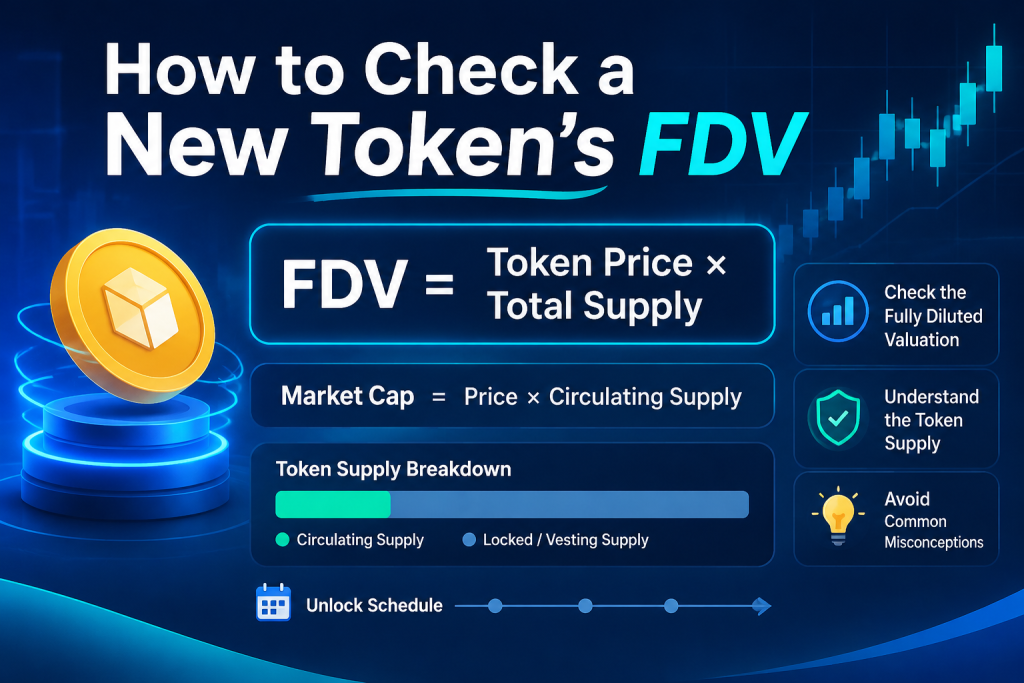
A new crypto token launches with a price of $0.05. Its circulating market capitalization is only $25 million, which may initially look attractive. But there is one important number you have not checked yet: its fully diluted valuation (FDV). If the project has a total supply of 10 billion tokens, its FDV is actually $500 million.
This difference can completely change how you evaluate a new token, especially when participating in an airdrop, buying during a Token Generation Event (TGE), or trading a newly listed asset.
A low market cap does not automatically mean a token is undervalued. A small initial circulating supply can make a token appear inexpensive while a large amount of team, investor, and ecosystem supply remains locked for future release.
This guide explains how to check a new token’s FDV, where to find reliable supply data, how to calculate its valuation manually, and how to evaluate upcoming unlocks before deciding whether an airdrop or new token launch deserves your attention.
1. What Is FDV in Crypto?
FDV stands for Fully Diluted Valuation. It estimates the total market value of a cryptocurrency if its entire relevant token supply were valued at the current market price.
Unlike market capitalization, which uses circulating supply, FDV considers the broader token supply, including tokens that may currently be locked, vested, or reserved for future distribution.
For example, assume a new project launches with these figures:
| Metric | Example Value |
|---|---|
| Token price | $0.05 |
| Total supply | 10 billion tokens |
| Circulating supply | 500 million tokens |
| Market capitalization | $25 million |
| Fully diluted valuation | $500 million |
| Circulating / total supply | 5% |
| FDV / Market Cap | 20x |
The token has a market capitalization of $25 million, but its FDV is $500 million. Only 5% of the total supply is circulating.
This does not prove that the token is overvalued. However, it means buyers are paying a price that implies a much larger fully diluted valuation than the current circulating market capitalization suggests.
CoinGecko explains FDV as a valuation calculated using token price multiplied by total supply. Its methodology also distinguishes circulating supply, total supply, and maximum supply, which should not be treated as interchangeable figures.
2. How to Check a New Token’s FDV: Five Practical Steps
When researching an upcoming token, do not rely on a single market-data page. The most useful approach is to cross-check its market price, supply information, and official tokenomics documentation.
Find the Token’s Official Contract Address
Start by identifying the correct token contract or mint address. This is especially important for newly launched Solana, Ethereum, and BNB Chain tokens because several unrelated assets can share the same ticker or token name.
Check the project’s official website, documentation, verified social channels, and official TGE announcement. Match the contract address against the asset listed on the relevant market-data platform.
For DEX launches, use DEX Screener to inspect the trading pair, price, liquidity, and fully diluted valuation where available.
For listed assets, CoinGecko and CoinMarketCap are useful starting points for checking supply and market statistics.
Check the Current Token Price
Once you have confirmed the correct asset, find its latest trading price.
For a newly listed token, check more than the headline price. Look at the following:
- Current spot price and the trading pair.
- DEX or CEX trading volume.
- Available liquidity in the trading pool.
- Price differences across supported exchanges.
- Whether the price comes from actual trading or a pre-market indication.
A token with a very small liquidity pool may show a high quoted price even when relatively little capital can actually trade at that price.
For example, a new token might display a $0.10 price and a $1 billion FDV, but its liquidity pool may contain only a small amount of available capital. That valuation is mathematically valid based on the quoted price and supply, but it does not mean the entire token supply could be sold at that valuation.
Find Total Supply, Maximum Supply, and Circulating Supply
This is the most important step in checking FDV accurately.
Look for the project’s official tokenomics documentation, token distribution announcement, whitepaper, or token contract. You need to distinguish three supply figures.
| Supply Metric | What It Means | Why It Matters |
|---|---|---|
| Circulating Supply | Tokens considered available in the public market. | Used to calculate market cap. |
| Total Supply | Tokens already created, excluding permanently burned tokens. | Common denominator for FDV. |
| Maximum Supply | The maximum number of tokens that can exist under the token’s supply rules. | Shows the potential long-term supply ceiling. |
These figures can differ significantly. A token may have 2 billion tokens already minted, 800 million circulating, and a maximum supply of 10 billion.
In that situation, using the maximum supply instead of total supply produces a different valuation calculation. You should identify which supply metric the data provider uses and explain the denominator when publishing your analysis.
For tokens with a fixed maximum supply, a maximum-supply-based FDV is often useful for assessing the fully issued scenario. For tokens with no fixed supply cap, a conventional maximum-supply FDV may not be available.
Also check whether the project has a mint function, an inflation mechanism, or a planned supply expansion. A fixed supply figure in an old tokenomics document may no longer represent the current contract rules.
Calculate FDV Manually
Once you have the current price and relevant supply figure, calculating FDV is straightforward.
Suppose a new token has a price of $0.08 and a total supply of 5 billion tokens.
Its implied FDV is $400 million.
Now assume only 400 million tokens are circulating:
The token therefore has a $32 million circulating market cap and a $400 million FDV. Its FDV is 12.5 times its market cap.
You can also calculate the circulating supply ratio:
Only 8% of the total supply is currently circulating. The remaining 92% represents supply that may enter circulation through future releases, subject to the project’s actual tokenomics and distribution rules.
Compare FDV with Other Projects in the Same Sector
A $400 million FDV cannot be judged in isolation. Whether it is reasonable depends on the project’s sector, adoption, revenue model, token utility, market conditions, and competing protocols.
For example, compare a new decentralized AI network with other AI infrastructure projects rather than using the FDV of an established payment token as the main benchmark.
Check:
- Market capitalization and FDV of comparable projects.
- Actual users and recurring protocol activity.
- Revenue, fees, or other measurable economic activity.
- Token utility and mechanisms connecting network growth to token demand.
- Fundraising valuation and the terms offered to early investors.
- Upcoming unlocks relative to current circulating supply.
Funding valuations are useful historical references, but they are not automatically equivalent to a fair public-market FDV. Private financing terms, token rights, vesting conditions, and public-market liquidity can be very different.
3. FDV vs. Market Cap: Why the Difference Matters for New Tokens
One of the most common mistakes in new coin research is comparing projects using market capitalization alone.
Imagine two projects with the following launch statistics:
| Metric | Token A | Token B |
|---|---|---|
| Token Price | $0.10 | $0.20 |
| Circulating Supply | 100 million | 800 million |
| Total Supply | 10 billion | 2 billion |
| Market Cap | $10 million | $160 million |
| FDV | $1 billion | $400 million |
| Circulating Ratio | 1% | 40% |
Token A has a much smaller market cap, which may initially attract traders searching for early-stage opportunities. However, its FDV is 2.5 times higher than Token B’s.
Only 1% of Token A’s supply is circulating, compared with 40% for Token B.
This creates a different supply risk. Token A has a much larger amount of future supply relative to its existing float.
CoinGecko also provides a Market Cap / FDV metric. A ratio closer to 1 means the current market capitalization is closer to the fully diluted valuation, assuming the underlying supply figures are comparable.
4. Check Token Unlocks Before Trusting a New Token’s FDV
FDV tells you what a token would be worth if the relevant supply were valued at the current price. It does not tell you when locked tokens will become transferable or how much additional supply will reach the market next month.
This is why checking the vesting schedule is essential.
Understand the Main Token Allocation Categories
Start by reviewing the project’s token distribution table. Pay particular attention to:
- Team and Advisors: Tokens allocated to founders, employees, and advisors, often subject to long vesting periods.
- Private Investors: Allocations to venture capital firms and early strategic investors.
- Community and Airdrops: Tokens reserved for users, early contributors, and ecosystem participants.
- Ecosystem and Treasury: Funds intended for grants, development, incentives, and future partnerships.
- Liquidity and Market Making: Tokens allocated to exchange liquidity and market operations.
Do not assume every unlocked token immediately enters the circulating supply. Some tokens may be unlocked but remain in treasury or other project-controlled wallets. Check both the contractual release conditions and the circulating-supply methodology.
Calculate an Unlock as a Percentage of Existing Circulating Supply
A useful calculation is:
For example, if a token currently has 500 million circulating tokens and 100 million tokens are scheduled to unlock, the release represents 20% of the existing circulating supply.
This is more informative than looking only at the percentage of maximum supply. A release representing 1% of maximum supply could still be significant if the current circulating supply is very small.
Real-World Example: Allora (ALLO) and Huma Finance (HUMA)
November 2026 provides two useful examples of why unlock schedules should be checked alongside FDV.
RootData’s September 30, 2026 Q4 tokenomics research reported that Allora investors and core contributors were allocated 31.05% and 17.5% of total supply, respectively. After a one-year cliff, the first 33% release from each allocation was estimated at approximately 160.2 million tokens combined.
Against the approximately 250 million circulating tokens reported in the research, that release represented roughly 64% of the existing float. Including concurrent ecosystem and other releases, the research cited approximately 163.9 million tokens in total.
The important point is not that all unlocked tokens will be sold. It is that the release is large relative to the existing circulating supply, making liquidity, holder behavior, and actual token demand important variables.
Huma Finance’s first major team, advisor, and investor unlock was postponed from May 26 to November 26, 2026, according to RootData’s Q4 research.
RootData estimated the first insider tranche at approximately 332.5 million HUMA, assuming equal releases over the following 12 quarters. Including other concurrent allocations, its estimate was approximately 459 million to 479 million tokens.
A more recent Tokenomics.com unlock schedule lists 478,620,000 HUMA for November 26, equivalent to 4.8% of maximum supply and approximately 13.4% of its reported current market capitalization at the time of its snapshot.
This is a useful distinction: 4.8% of total supply may sound relatively modest, but 13.4% of current market cap is a different measure of potential supply pressure.
These examples show why a token’s FDV should never be assessed without checking its upcoming supply changes. Two projects with similar FDVs can have very different market risks depending on how much supply is scheduled to enter circulation.
5. A Real TGE Valuation Example: MagicBlock (BLOCK)
Pre-TGE projects present a different challenge. They may have published total supply and fundraising terms without having a confirmed public trading price or initial circulating supply.
MagicBlock’s BLOCK token is a useful example because its published tokenomics provide a concrete valuation reference while its public launch schedule remains unconfirmed in the October 30, 2026 project review.
BLOCK Token Supply and Allocation
MagicBlock disclosed a fixed total supply of 10 billion BLOCK, allocated as follows:
| Allocation | Percentage | Token Amount |
|---|---|---|
| Community | 35% | 3.5 billion |
| Investors | 20% | 2 billion |
| Team and Advisors | 18% | 1.8 billion |
| Node Operators | 15% | 1.5 billion |
| Ecosystem Fund | 12% | 1.2 billion |
| Total | 100% | 10 billion |
The February 2026 fixed-price presale option used a $100 million FDV reference. With 10 billion tokens, the implied token price is:
That provides a mathematical reference for evaluating the published sale terms. It does not establish a future exchange price or prove that the project is worth $100 million in the open market.
How Different Prices Change BLOCK’s FDV
| Hypothetical Price | Implied FDV |
|---|---|
| $0.005 | $50 million |
| $0.01 | $100 million |
| $0.02 | $200 million |
| $0.05 | $500 million |
| $0.10 | $1 billion |
Notice how quickly the valuation changes. A token price of $0.10 would imply a $1 billion FDV, ten times the $100 million presale reference.
However, there is another important variable: initial circulating supply.
If 1 billion BLOCK tokens were circulating at a hypothetical price of $0.01, the circulating market capitalization would be $10 million, while FDV would remain $100 million. If 2 billion tokens circulated at the same price, market cap would increase to $20 million without changing FDV.
These are scenarios rather than confirmed BLOCK launch figures. As of the October 30, 2026 review, the project had not confirmed a replacement TGE date or an official initial circulating supply.
For the complete token distribution, presale structure, project development, and launch status, read our MagicBlock BLOCK TGE and Tokenomics Guide.
6. How to Judge Whether a New Token’s FDV Is Too High
There is no universal FDV threshold that separates a good token from a bad one. A $500 million FDV could be reasonable for an established protocol with significant recurring demand, but difficult to justify for a project that has not yet launched its main product.
Instead of relying on an arbitrary valuation limit, use the following framework.
Check FDV Against Actual Project Activity
Look beyond the project’s social media followers and fundraising announcements.
- Does the protocol have an operational product?
- Are users returning after initial incentives end?
- Is there measurable transaction volume?
- Does the protocol generate fees or recurring revenue?
- Does token ownership provide a real economic or governance function?
A project can attract millions of dollars in funding without creating equivalent demand for its token. Equity investors, token holders, and protocol users do not necessarily have the same economic interests.
Check FDV Against Fundraising Valuations
Private fundraising and public trading provide different valuation references.
If early investors purchased tokens at a $100 million FDV and a new token lists at a $1 billion FDV, the difference is significant. But you should also examine whether the private allocation was discounted, locked, subject to different rights, or purchased under a different market environment.
Do not assume that a public-market FDV is fair simply because it is above the last funding valuation. Equally, a public price below the private valuation does not automatically mean the token is undervalued.
Check FDV Against Future Supply
Review the next 30, 90, and 180 days of scheduled releases. Calculate each release relative to current circulating supply, rather than looking only at its percentage of maximum supply.
Also identify whether releases are linear, monthly, quarterly, or cliff-based. A large cliff unlock creates a different supply event from the same amount distributed gradually over several years.
Check Whether Token Demand Can Absorb New Supply
Unlocks create the potential for additional market supply, not a guaranteed price decline. The impact depends on whether recipients sell, hold, stake, or use their tokens, and whether market demand increases at the same time.
Compare the expected release with actual liquidity, trading volume, buyback activity, and sustainable token demand. A large unlock in a thin market deserves more attention than the same percentage released into a deep, actively traded market.
7. Common FDV Mistakes When Researching Airdrop Tokens
Mistake 1: Assuming a Low Token Price Means a Cheap Valuation
A token priced at $0.001 is not necessarily cheaper than one priced at $10. Token price depends heavily on the number of tokens in existence.
Always calculate FDV and circulating market cap before comparing token prices.
Mistake 2: Treating FDV as the Amount of Money Invested
FDV is a valuation calculation, not the amount of capital invested in a project. A $1 billion FDV does not mean investors have put $1 billion into the token.
The figure assumes that all relevant tokens are valued at the current market price. It does not establish that the entire supply could be sold at that price.
Mistake 3: Ignoring the Difference Between Total Supply and Maximum Supply
Some data providers calculate FDV using maximum supply, while other valuation references may use total supply. For projects with additional minting or inflation, the distinction can become especially important.
Always state which supply denominator you are using.
Mistake 4: Assuming All Unlocked Tokens Are Circulating
Unlocked does not necessarily mean publicly circulating. Tokens may remain in treasury wallets or be held by project-controlled addresses. Check the actual circulating-supply methodology and relevant wallet information.
Mistake 5: Ignoring Airdrop Distribution
A large community allocation may look attractive, but the initial airdrop can introduce additional circulating supply. Check how much is claimable at TGE, whether there is a vesting period, and whether unclaimed tokens are redistributed, burned, or retained.
For airdrop participants, this matters because a large theoretical allocation does not guarantee a high realized reward. The value depends on the actual claim amount, unlock conditions, token price, and available market liquidity.
8. New Token FDV Research Checklist
Before participating in a new token launch or claiming an airdrop, use this checklist to organize your research.
- Verify the official token contract or mint address.
- Confirm the correct trading pair and network.
- Check whether the asset has actual spot trading.
- Record the current token price.
- Find circulating supply, total supply, and maximum supply.
- Calculate market cap and FDV separately.
- Calculate the circulating supply ratio.
- Compare valuation with relevant competitors.
- Review investor, team, community, and treasury allocations.
- Check vesting and unlock schedules.
- Calculate upcoming unlocks as a percentage of circulating supply.
- Identify inflation, minting, and burn mechanisms.
- Check DEX liquidity and trading volume.
- Review potential market-making and exchange support.
- Evaluate whether actual demand can absorb additional supply.
9. Useful Tools for Checking New Token FDV
These tools can help you verify token information and monitor new listings. Use multiple sources because newly launched tokens may have incomplete or inconsistent supply data.
| Tool | What to Check | Best Use |
|---|---|---|
| CoinGecko | Market cap, FDV, circulating supply | Listed token valuation |
| CoinMarketCap | Token supply and market statistics | Market data cross-check |
| DEX Screener | DEX price, liquidity, volume, FDV | New DEX launches |
| RootData | Funding, investors, project information | Early-stage project research |
| Tokenomist | Vesting allocations and unlock schedules | Future supply analysis |
| Tokenomics.com | Tokenomics and unlock calendars | Upcoming token releases |
For users tracking new launches and airdrop opportunities, CdropBot provides an additional starting point for discovering newly launched tokens, upcoming TGE events, airdrop campaigns, and project research.
You can also explore our Token Intelligence section for tokenomics, project fundamentals, and supply-related analysis, or visit New Coin Airdrop Guides for practical information on airdrop eligibility, claim procedures, and farming strategies.
10. Frequently Asked Questions About Checking FDV
What is a good FDV for a new crypto token?
There is no universal good FDV. A reasonable valuation depends on the project’s sector, adoption, revenue, token utility, comparable protocols, and future supply. Compare similar projects and examine whether the implied valuation is supported by actual demand.
How do I calculate FDV without a crypto tracking website?
Multiply the current token price by the relevant total supply. For example, a token priced at $0.02 with 1 billion tokens has an FDV of $20 million. Make sure the supply figure is accurate and clarify whether you are using total supply or maximum supply.
Is a low market cap and high FDV a red flag?
It is a reason to investigate further. A large gap can indicate that much of the supply is locked or reserved for future distribution. Check the vesting schedule, initial circulating ratio, and upcoming unlocks before making a decision.
Does a high FDV mean a token is overvalued?
Not necessarily. A high FDV may be justified by strong product adoption, recurring demand, valuable token utility, and a sustainable supply schedule. However, if the valuation is supported mainly by speculation rather than measurable activity, the risk is higher.
Why is FDV different from market cap?
Market capitalization uses circulating supply, while FDV uses the broader relevant token supply. If a project has 100 million circulating tokens and 1 billion total tokens, FDV will be ten times market cap at the same token price.
Can FDV decrease when a token unlocks?
An unlock does not automatically decrease FDV. FDV is calculated using price and supply. If total supply remains unchanged, an unlock that merely moves existing tokens into circulation does not change FDV at an unchanged price. However, additional selling pressure may affect the market price and therefore the FDV.
Should airdrop hunters check FDV before claiming tokens?
Yes. FDV helps you understand the implied valuation at the current price, while circulating supply and unlock schedules reveal how much additional supply may enter the market. Also consider claim fees, vesting restrictions, liquidity, and whether the token can actually be traded.
Is FDV the same as a project’s fundraising valuation?
No. Fundraising valuations may refer to equity, token warrants, or private token-sale terms. FDV is a market-price-based calculation using token supply. Compare the two only after understanding the rights, discounts, vesting, and supply assumptions behind each figure.
Final Thoughts
Checking a new token’s FDV should be one of the first steps in evaluating an airdrop, TGE, or newly listed cryptocurrency. However, the number alone cannot tell you whether a project is a good opportunity.
The more useful approach is to combine FDV with circulating market capitalization, token allocation, unlock schedules, real project activity, and available liquidity. A token with a small market cap may already imply an aggressive fully diluted valuation, while a large upcoming unlock can introduce additional supply relative to the existing float.
Before buying or holding a newly launched token, verify its contract address, calculate its valuation independently, and understand who receives the remaining supply and when those tokens become transferable.
For airdrop hunters, the goal is not simply to find tokens with the lowest FDV. It is to understand what valuation the market is assigning to the project, how much future supply could enter circulation, and whether actual demand can support that valuation.